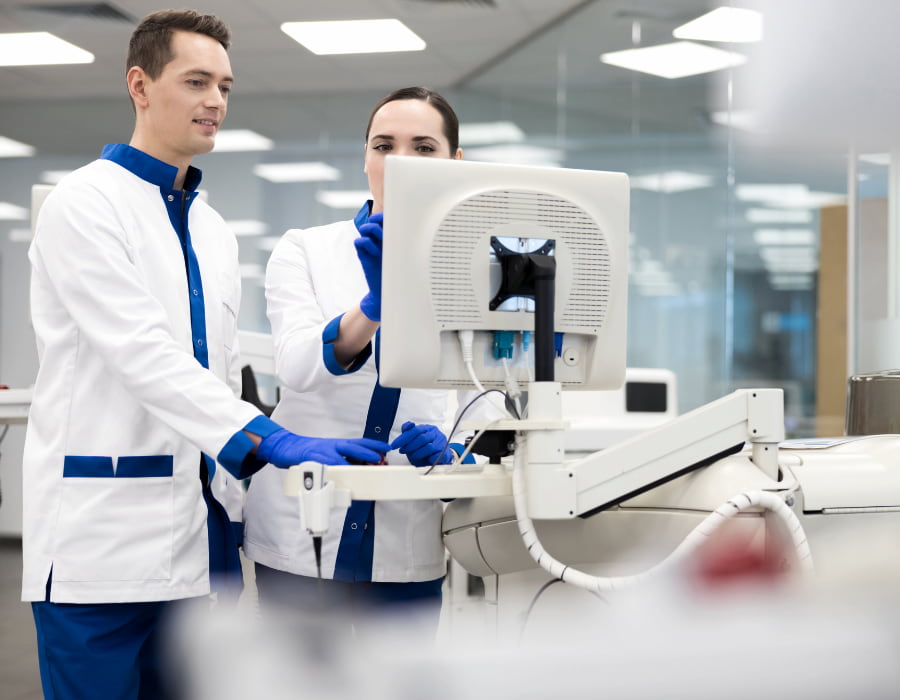
Total laboratory automation is considered to be a game changer in the world of clinical laboratories. These innovative systems are revolutionising the way laboratories perform and are being rolled out in clinical labs around the world.
In this article, we’re going to outline the pros and cons of total laboratory automation (TLA) and highlight how it may impact microbiology.
What Is Total Laboratory Automation?
Total laboratory automation is an innovative system that is designed to seamlessly automate manual processes and highly repetitive tasks in a laboratory setting.
Software, laboratory instruments and automated equipment including robotics are custom-built to meet the needs of the laboratory. Once they have been successfully implemented, minimal human intervention is required.

What Are The Benefits Of Total Laboratory Automation?
Lie most technological breakthroughs, total laboratory automation has a wide range of benefits. For example, TLA systems can significantly increase efficiency by reducing human errors, improving the speed of testing procedures and allowing for a higher quantity of repetitive tasks to be carried out at one time.
Total laboratory automation also ensures consistent quality by improving accuracy and reducing questionable results. In addition, total laboratory automation can reduce laboratory spending costs in the long run by eliminating costly manmade mistakes and reducing the need for more laboratory staff members.
Are There Any Downsides To TLA Systems?
Despite being beneficial for laboratories, including microbiology laboratories, total laboratory automation also has its downsides. The introduction of a streamlined automated way of working will significantly change the landscape of a busy lab by reducing the need for as many team members.
This may also lead to the microbiology industry having few clinical laboratory experts who are skilled and knowledgeable in specific processes.
Another downside to total laboratory automation is the high cost of installing and implementing the system. Changes will have to be made to the clinical laboratory to make space for the large hardware required.
From powerful air conditioning units to soundproofing, the environmental modifications required to install a TLA system will be costly. As is the TLA system itself! The laboratory will also have to pay for ongoing maintenance and supplies needed to successfully run the total laboratory automation.
As well as the high installation costs, the implementation of a TLA system will also be disruptive to the laboratory. Implementing a TLA system requires in-depth planning and may take weeks or even months to fully complete. This can be incredibly disruptive to the team working in the clinical laboratory.
How Will It Impact The Microbiology Industry?
Total laboratory automation systems are becoming increasingly popular within clinical microbiology laboratories.
By automating sample handling and preparation, improving data management and automating overall workflow with the use of integrated instruments, robotics and mechanisation, TLA systems offer a wide range of benefits for microbiology laboratories.
One of the biggest impacts is the improved speed and efficiency of results. Total laboratory automation systems also enable microbiologists and laboratory technicians to improve their identification and testing procedures, whilst increasing the speed of achieving desired results.
Did you find this article helpful? You can check out our website for more awesome content like this.
Read Also
- Innovative Technologies in Oncology: The Future of Cancer Treatment
 Have you ever wondered how far cancer treatment has come in recent years? Advances in technology are making a real difference in the fight against cancer. Today, more people are living longer and healthier lives after a cancer diagnosis. This is all thanks to new and groundbreaking medical advancements. The future of cancer care looks… Read more: Innovative Technologies in Oncology: The Future of Cancer Treatment
 - Cloud-Based Healthcare Administration Solutions: A Guide for Payers, TPAs, and Provider NetworksHealthcare administration has become too complex for disconnected spreadsheets, aging on-premise applications, and manual handoffs between departments. Organizations need technology that can manage claims, enrollment, billing, provider relationships, and member data as connected parts of the same operation. MCSI – Visova is one example, offering a cloud-native vpaas designed to support HIPAA-compliant healthcare administration. Its… Read more: Cloud-Based Healthcare Administration Solutions: A Guide for Payers, TPAs, and Provider Networks
- How Intelligent Invoice Processing Is Reshaping Healthcare AP WorkflowsWhat happens when healthcare invoice volumes outpace the AP team’s ability to review, validate, and route them, while cost per invoice keeps rising? That gap is pushing finance leaders past basic digitization. Supplier invoices across formats, systems, departments, and approval paths, and holding speed, accuracy, compliance, and visibility together gets harder at scale. Intelligent invoice… Read more: How Intelligent Invoice Processing Is Reshaping Healthcare AP Workflows
- From 1905 to 2026: How German Legacy Manufacturers Power Deutsche Dental Technologien’s SuccessFrom 1905 to 2026: How Busch & Co.’s Legacy Powers Deutsche Dental Technologien’s Success In an era where dental technology advances at breakneck speed, few companies embody the perfect blend of historic craftsmanship and modern business agility quite like Busch & Co. and its strategic partner Deutsche Dental Technologien. What began as a small dental bur factory in… Read more: From 1905 to 2026: How German Legacy Manufacturers Power Deutsche Dental Technologien’s Success
- Why the Future of Healthcare Administration is Cloud-NativeThe operational demands placed on modern healthcare administrators have officially outpaced the capabilities of traditional IT infrastructure. While clinical medicine continues to advance at breakneck speed, the back-office systems required to support it often remain painfully stagnant. Today’s insurers, Third-Party Administrators (TPAs), and provider networks are forced to navigate an avalanche of daily claims, aggressive… Read more: Why the Future of Healthcare Administration is Cloud-Native
- The Digital Overhaul: Why Modern Healthcare Administration Demands Advanced Technology SolutionsLet’s be honest about the current state of healthcare administration: it is staggering under its own complexity. The days of managing patient populations, claims, and provider networks with spreadsheets and disjointed legacy systems are long gone. Today, the sheer volume of data processing required just to keep a healthcare organization afloat is enough to paralyze… Read more: The Digital Overhaul: Why Modern Healthcare Administration Demands Advanced Technology Solutions
- Tech-Enabled Healthcare Innovation in Physical Therapy CarePhysical therapy is changing with the help of new technology. Digital tools are now used to support recovery and improve care. These tools help therapists track progress in a better way. Explore how technology is reshaping physical therapy with innovative digital tools. It highlights smarter recovery and patient outcomes in healthcare. Continue reading to discover… Read more: Tech-Enabled Healthcare Innovation in Physical Therapy Care
- 5 Best Payroll Error Detection Software for Healthcare in 2026Healthcare organizations operate some of the most complex payroll environments in any industry. Hospitals, skilled nursing facilities, rehabilitation centers, physician groups, and home healthcare providers must manage thousands of employees working across different shifts, departments, facilities, and compensation structures. Payroll teams are expected to process this information accurately while complying with labor regulations, organizational policies,… Read more: 5 Best Payroll Error Detection Software for Healthcare in 2026